
GestaCare Veg Sachets
Preconception, pregnancy and postpartum
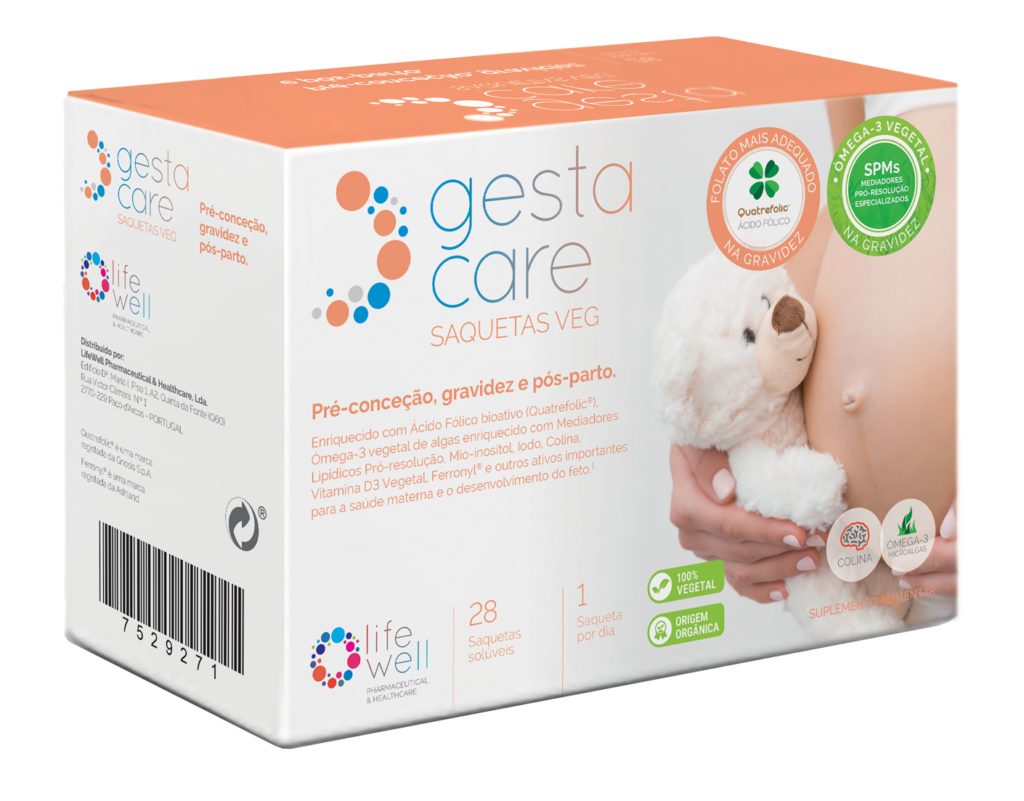
GestaCare Veg Sachets
It is an international reference supplement, developed for preconception, pregnancy and the postpartum period.
It aims to eliminate the risk of micronutrient deficiency that are essential to good fetal development, prevention of the development of birth defects, good obstetric outcome and maternal health.
Its presentation in sachets and solubility in water make this supplement the ideal choice for women who find it difficult to swallow capsules or tablets and promotes hydration at a time when fluid intake should be even more frequent.
The formulation of GestaCare Veg is of plant and organic origin, which reinforces the safety of its compounds at such an important stage in the life of the mother and the developing fetus, and guarantees greater tolerability compared to formulas with compounds of animal origin.
GestaCare Veg Sachets has been specially developed without sugar and is therefore suitable for pregnant women with gestational diabetes.
Pregnancy Symptoms?
In general, the first symptoms of pregnancy arise from 2 to 3 weeks after sexual intercourse that gave rise to pregnancy.
The first signs arise only when the embryo implants in the uterus.
The most common pregnancy symptoms are: menstrual delay, abdominal cramps or pain, breast pain and enlargement, nausea and vomiting, swollen belly, tiredness and excessive sleep, food cravings, frequent urge to urinate, mood swings, changes in taste and smell, constipation and oily skin.
Although there is pregnancy without nausea, nausea and vomiting are a classic symptom of pregnancy. They can go from a simple morning malaise to repeated vomiting.
Up to 80% of pregnant women experience nausea and vomiting at a certain point in pregnancy.
It is essential to carry out a pregnancy test, purchased at a pharmacy, or by blood collection, to confirm or lose any suspicion.
After confirming your pregnancy, you should seek immediate contact with your obstetrician in order to start your prenatal follow-up as soon as possible. Prenatal care, any necessary medication and especially prenatal supplementation, are fundamental for your health and to ensure the best development of your foetus and prevent potential birth defects.
The DGS (Directorate-General for Health), through the National Program for the Surveillance of Low-Risk Pregnancy, reiterates the importance of an early and continuous start to prenatal surveillance.
Find out more about GestaCare Veg Sachets, available from your usual pharmacy or from the lifewell.co.uk online store.
GestaCare Veg - What is it?
It is a state-of-the-art formulation, developed according to the highest quality and safety parameters, with the latest technology and in accordance with the highest international production standards, intended for preconception, pregnancy and postpartum.
Essential for fetal growth and development, and support for the formation of the fetal neural tube. It contains active ingredients that play important roles in the development of the fetus’ brain, bones, nervous system, blood and other organs.
Prenatal supplementation helps reduce the risk of pregnancy complications and helps strengthen the mother’s immune system, making her less susceptible to infections during pregnancy.

GestaCare Veg Sachets aims to eliminate the risk of deficiencies in micronutrients that are essential for good fetal development and maternal health.
The risk of disability, when occurring during pregnancy, can have maternal-fetal repercussions that are sometimes irreversible and have sub-clinical manifestations.
The period of greatest environmental sensitivity for the fetus is between 17 and 56 days after fertilization. It is during this period that organogenesis begins, even before many women even recognize that they are pregnant or have the opportunity to start prenatal care.
It already has state-of-the-art folic acid in its composition, Quatrefolic (see information below).
GestaCare Veg Sachets has a specific formulation for women, whether they are in the pre-conception, pregnancy or post-partum phase, in line with the latest national and international guidelines.
GestaCare Veg Sachets – See in store
Nutritional needs in the Pre-Conception, Pregnancy and Post-Partum periods
Nutrition plays a crucial role at all stages of life, but it becomes particularly vital during the preconception, pregnancy and postpartum periods. Each of these stages requires specific care to ensure the health of mother and baby, promoting healthy development and preventing complications.
Preconception: Preparing the body for new life
The pre-conception phase is an opportunity to optimize nutritional health and prepare the body for pregnancy. A balanced diet, rich in vitamins and minerals, is essential. Nutrients such as folic acid, iron, calcium and omega-3 are key to reducing the risk of birth defects and improving fertility. In addition, it is important to maintain a healthy weight and adopt an active lifestyle.
Pregnancy: Nurturing two lives
During pregnancy, nutritional needs increase significantly. Adequate intake of proteins, complex carbohydrates, healthy fats, vitamins and minerals is essential to support the baby’s growth and development, as well as maintaining the mother’s health. Nutrients such as iron, folic acid, calcium and vitamin D are particularly important. Adequate hydration and choosing fresh, nutritious food can prevent complications such as anemia, hypertension and gestational diabetes.
Postpartum: Recovery and breastfeeding
The postpartum period is a time of recovery for the mother and adaptation for the baby. Breastfeeding requires an increase in calorie and nutritional needs to ensure the production of quality breast milk. Proteins, healthy fats, vitamins and minerals remain essential, along with adequate hydration. In addition, a balanced diet helps with postpartum recovery and improves the mother’s energy and emotional well-being.

Plant and organic supplementation
Supplementation of plant and organic origin is especially important during pregnancy as it tends to be better tolerated by pregnant women at a time when they are prone to nausea, vomiting and other gastrointestinal discomforts. The fact that it does not contain compounds of animal origin reduces the risk of allergens or adverse reactions (e.g. fish and shellfish) and does not interfere with or aggravate the symptoms of gastrointestinal disc omfort often associated with pregnancy. This guarantees the intake of essential nutrients without any additional discomfort and without compromising the effectiveness of supplementation.
Scientific studies show that plant ingredients can be just as, if not more, effective than their synthetic counterparts, providing a wide range of essential nutrients that promote health and well-being. The focus on plant-based and natural supplements also responds to a growing ethical and environmental concern, ensuring that products are animal cruelty-free and more sustainable.
Why choose supplements in sachets?
Supplementation in sachets, which are soluble in water, offers several benefits and added value compared to classic supplementation in tablets:
- Rapid absorption: The liquid form allows nutrients to be absorbed more quickly and efficiently by the body.
- Easy to swallow: Ideal for women who have difficulty swallowing tablets, especially during pregnancy.
- Convenience: Convenient to take and consume anywhere, just add water.
- Best taste: There are several flavors, which make supplementation more pleasant.
- Hydration: Drinking water promotes greater hydration – particularly relevant in the pre-conception, pregnancy or post-partum phases, when fluid intake should be increased.

Supplementation in pregnancy:
Folic acid (or Vitamin B9) in gestational supplementation is crucial for preventing neural tube defects, such as spina bifida, and anencephaly in the fetus. In addition, it contributes to the proper formation of the brain and spinal cord, reducing the risk of other congenital complications and helping the healthy development of the baby’s nervous system. It can also reduce the incidence of premature birth and improve the mother’s general health during pregnancy.
Folic acid supplementation is particularly important before and during early pregnancy. Studies indicate that three out of four congenital neural tube defects can be prevented with adequate folic acid intake, ideally starting 3 to 6 months before conception and continuing throughout the first 12 weeks of pregnancy.
The GestaCare supplementation range contains the latest generation of folic acid, Quatrefolic®.
O Quatrefolic® (Vitamin B9, Folic Acid) or Bioactive Folic Acid is a patented biologically active folate that differs from the synthetic folic acid normally found in other supplements in that it is a final form of folate that the body can immediately use without any need for metabolization, thus guaranteeing the recommended daily dose and preventing a potential build-up of unmetabolized folic acid in the blood.
This advance in supplementation ensures efficient absorption and crucial nutritional support for the prevention of birth defects, promoting a healthier and safer pregnancy.
Learn more about Quatrefolic® the latest generation folic acid in GestaCare.
Choline in gestational supplementation is essential for the brain and cognitive development of the fetus, contributing to the proper formation of the neural tube and preventing birth defects. In addition, choline helps in the formation of cell membranes, the transmission of nerve signals and lipid metabolism. Studies suggest that choline can improve the baby’s long-term memory and cognitive function and reduce the risk of complications such as pre-eclampsia (high blood pressure) in the mother.
Iron in combination with some micronutrients helps to increase blood volume and prevent anemia. It is important for energy metabolism and for the development of the fetal nervous system.
The deficit of this mineral may lead to increased risk of low birth weight, prematurity, perinatal mortality and disturbances in neuronal development. A daily intake of 30 mg is ideal during pregnancy, and supplementation with this mineral is necessary according to the latest scientific evidence.
Iodo deficiency during pregnancy compromises fetal cognitive development. Preconception women, pregnant or breastfeeding, should receive a daily Iod supplement of 150 to 200 μg/day, in accordance with national and international recommendations.
Iodo contributes to good neuronal development and cognitive ability, recent studies conducted in Portugal warn of inadequate iod intake in 80% of Portuguese pregnant women, so dgs strongly recommends supplementation.
Learn more at:
Review article: Iode supplementation in pregnancy: what is the importance?
Directorate General for Health (DGS) – Standard of Clinical Guidance No. 011/2013
Vitamin D is crucial for the bone health of both mother and fetus, promoting the absorption of calcium and phosphorus and preventing osteomalacia in the mother and rickets in the baby. In addition, vitamin D plays an important role in the immune system and can reduce the risk of gestational complications such as pre-eclampsia and gestational diabetes. Studies also suggest that adequate levels of vitamin D during pregnancy are associated with a lower risk of premature birth and low birth weight.
Zinc plays a crucial role in fetal growth and development, being essential for DNA synthesis, cell division and proper tissue formation. As well as contributing to the immune health of mother and baby, zinc is also important for wound healing and the proper functioning of the digestive and reproductive systems. Zinc deficiency during pregnancy can increase the risk of complications such as premature birth, low birth weight and inadequate development of the fetus’s central nervous system.
It helps regulate blood pressure, preventing complications such as pre-eclampsia. In addition, it is essential for the proper functioning of the muscles, including the uterus, helping to reduce the risk of premature contractions and promoting a more regular labor. It also contributes to the absorption of calcium, which is essential for the baby’s bone development. Magnesium deficiency during pregnancy can be associated with problems such as low birth weight and a higher incidence of premature birth.
DHA is critical for the growth and development of the fetal and infant central nervous system, as well as visual and neuronal function and neurotransmitter metabolism .
Supplements that include HDA of animal origin present a significant inconvenience for pregnant women as they aggravate nausea and vomiting induced by pregnancy itself. They usually have a strong fishy smell and taste, causing heartburn, reflux, gastrointestinal discomfort and poor digestion.
Best practice and current international recommendations strongly suggest the use of plant-based DHA in the particular context of pregnancy.
The source of DHA present in the composition of GestaCare is already of plant origin.
Learn more here.
The importance of Folic Acid present in GestaCare - Quatrefolic®

Perfect bioavailability and security
O Quatrefolic® (Vitamin B9, Folic Acid), also known as fourth generation folate, is a patented biologically active folate that differs from the synthetic folic acid normally found in other supplements in that it is a final form of folate that the body can immediately use without any need for metabolization, thus guaranteeing the recommended daily dose and preventing a potential build-up of unmetabolized folic acid in the blood.
This new folate contributes to the normal metabolism of homocysteine, process of cell division and growth of fetal and maternal tissues during pregnancy. Folate is essential for the prevention of congenital anomalies in the developing fetus and plays a role in the development of the newborn in the first months of life. This is the most up-to-date and advanced form of folate, which is why taking it is considered essential for all pregnant women throughout the pre-conception, pregnancy and post-partum phases.
Optimized properties
The importance of vitamin B9 is perfectly recognized and has been widely studied in young women and pregnant women to ensure a harmonious development of the fetus, limiting neural tube malformations. Deficiency is recognized in this element as one of the most frequent, and it is imperative to ensure an adequate and regular contribution in women of childbearing age.
Associated with vitamin B12, folates ensure the conversion of homocysteine into methionine. Taking a supplement with Quatrefolic® is therefore preferable to taking a folic acid supplement, as it is immediately available to react with homocysteine and thus prevent hyperhomocysteine.
Quatrefolic® is a registered trademark of Gnosis Spa. Copyright© 2018 Gnosis S.p.A. All rights reserved.
It is recommended to take 1 sachet a day, diluted in a glass of water, preferably with a meal.
Quatrefolic
Quatrefolic (Vitamin B9, Folic Acid) is a patented biologically active folic acid, which differs from synthetic folic acid normally found in other supplements because it is a final form of folate that the body can immediately use without any need for metabolization, thus ensuring the recommended daily dose and preventing a potential accumulation of unmetabolized folic acid in the blood.
This new folate contributes to the normal metabolism of homocysteine, process of cell division and growth of fetal and maternal tissues during pregnancy.
VEGETABLE DHA
Vegetable DHA is not extracted from fish oil, but from microalgae, using a current and technologically advanced process that is in line with international best practices and recommendations. This guarantees a vegetable DHA oil of superior quality and with unique characteristics, including a more pleasant aroma and taste, as well as a high absorption capacity. DHA is critical for the growth and development of the fetal and infant central nervous system, as well as visual and neuronal function and neurotransmitter metabolism.
Vegetable omega-3
Plant-sourced Omega-3 has a high concentration of EPA and DHA metabolites (14-HDHA, 17-HDHA and 18-HEPE). Lipid signaling agents known to uniquely promote the resolution of inflammation, interacting positively with various types of immune cells. Particularly important in maintaining good maternal health and preventing poor obstetric outcomes.
Mio-Inositol
Myo-inositol is a component of phosphatidylinositol. There is some evidence to suggest that prenatal and gestational supplementation with myo-inositol may reduce the incidence of gestational diabetes, hypertensive pathology associated with pregnancy, and preterm delivery. Women with a personal history of polycystic ovary syndrome or a family history of type 2 diabetes mellitus may benefit from myo-inositol supplementation.
Iodine
Iode contributes to normal energy-producing metabolism and to normal cognitive and central nervous system function.
Hill
The latest scientific evidence shows that choline in pregnancy is associated with fetal neurodevelopment, with a beneficial neurocognitive effect and a reduced risk of developing mental illnesses.
Vegetable Vitamin D3
Vegetable Vitamin D3 contributes to the process of cell division and to normal calcium levels in the developing fetus and pregnant women. It ensures optimal embryonic and fetal development, prevents the development of birth defects, supports the growth of maternal tissue, reduces the risk of low birth weight, premature birth, pre-eclampsia, high homocysteine levels and, consequently, poor obstetric outcomes. Its vegetable and/or organic origin is an added value for pregnant women who experience symptoms of nausea and vomiting during pregnancy, as it does not aggravate these symptoms and ensures greater tolerability.
Iron
Ferronyl® micronized and microencapsulated iron has the important function of transporting oxygen in the blood and is involved in the formation of haemoglobin and red blood cells. It does not cause abdominal discomfort.
Zinc
Zinc is a mineral element that contributes to the process of cell division and normal DNA synthesis.
Other Components
Minerals: Magnesium, Selenium. Vitamins: B1, B2, B3, B5, B6, B8 and B12.
Dietary supplements should not be used as substitutes for a varied diet. It is important to maintain a healthy lifestyle. Read the leaflet included in the packaging carefully. If in doubt, consult your doctor or pharmacist. Keep out of the sight and reach of children. Store in a cool, dry place. Todos os suplementos alimentares comercializados pela LifeWell foram fabricados de acordo com as melhores práticas internacionais de produção e devidamente examinados, validados e autorizados pelas respetivas autoridades de saúde em Portugal.
Editorial Note: This page and all other contents present in
lifewell.pt
are prepared and reviewed by medical experts in Portugal.